

March 29, 2026, Palm Sunday
Two Processions, Two Kingdoms
Today we enter Holy Week.
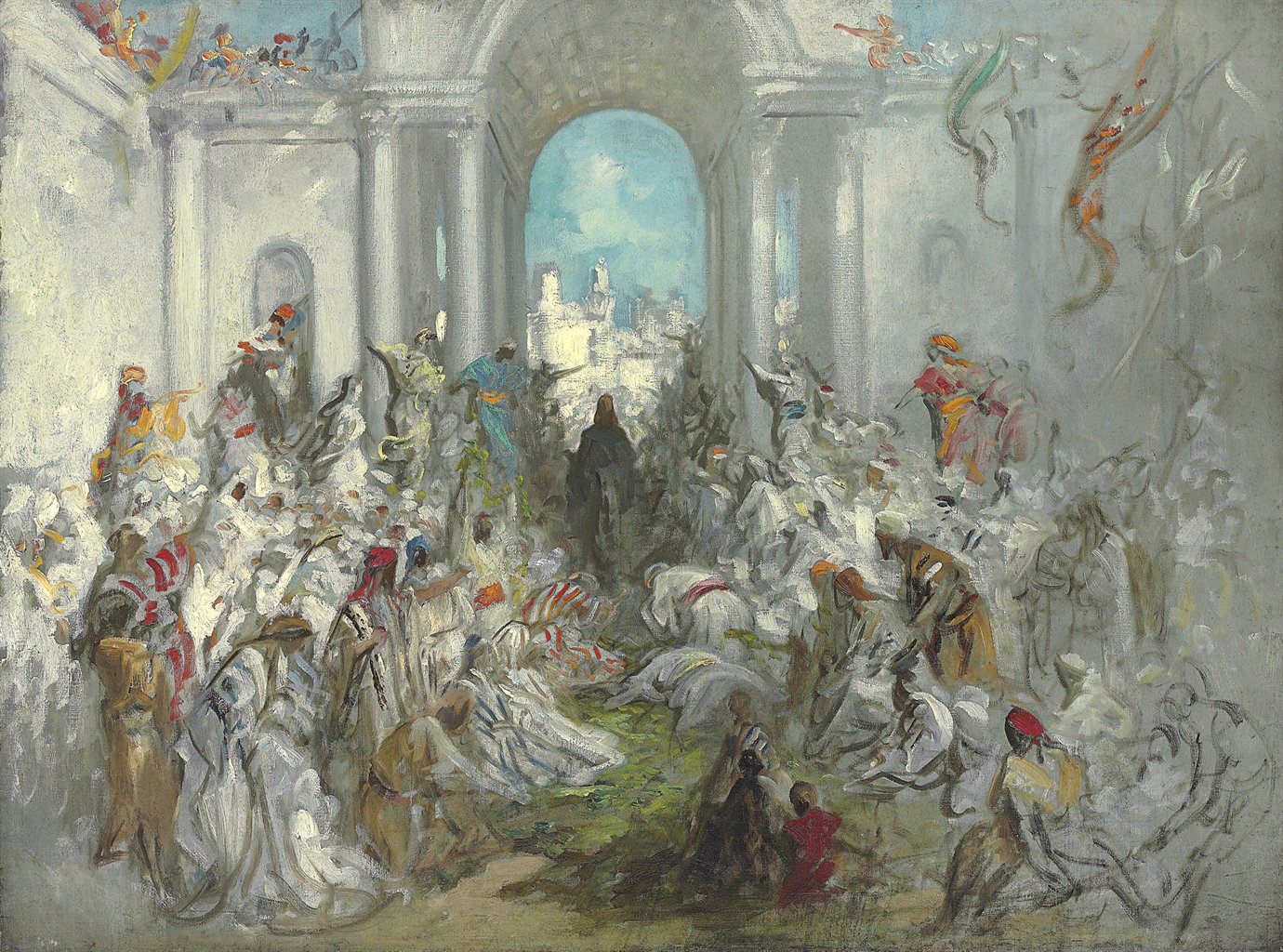
Doré, Gustave, 1832-1883. Christ's Entry into Jerusalem, from Art in the Christian Tradition, a project of the Vanderbilt Divinity Library, Nashville, TN. https://diglib.library.vanderbilt.edu/act-imagelink.pl?RC=57327
And as we do, the Gospel places before us one of the most powerful and unsettling stories in all of Scripture.
We began with palms raised, recalling Jesus’ entry into Jerusalem with shouts of “Hosanna!” But as the Passion according to Matthew unfolds, the cheers fade into betrayal, violence, and death. The story moves from triumph to tragedy in a matter of pages.
To understand this moment fully, it helps to see the scene not only as a religious event, but also as a political and cultural drama unfolding in a city on edge.
In Jerusalem on that first Palm Sunday there were two processions.
From the east came Jesus.
He rode on a humble donkey. Around him were peasants—farmers, fishermen, labourers. They waved branches and shouted words from the psalms: “Hosanna! Blessed is the one who comes in the name of the Lord!” This was the procession of the poor, the forgotten, the ones longing for God’s kingdom.
But from the west came another procession.
At its head was Pontius Pilate, the Roman governor of Judea, riding a magnificent warhorse. Behind him marched soldiers of the Roman legion, armour shining, banners flying, weapons ready.
They were entering the city for the same reason Jesus was.
It was Passover.
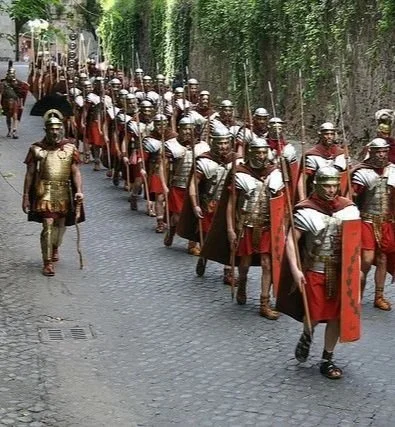
The annual Passover celebrations drew tens of thousands of pilgrims to Jerusalem. It was the festival celebrating Israel’s liberation from empire—God freeing the people from slavery in Egypt. For Rome, that kind of story was dangerous.
So, each year the governor came with troops to keep order. Rome called this the Pax Romana—the Peace of Rome.
But the Pax Romana was peace enforced by violence. Peace secured through domination and maintained by taxation, surveillance, and the crushing of dissent. If people resisted, Rome crucified them publicly along the roads as a warning.
Two processions entered Jerusalem that day.
One proclaimed the power of empire.
The other proclaimed the kingdom of God.
And the city, Matthew tells us, was in turmoil.
People were asking questions:
Who is this Jesus?
What does he mean for Rome?
What does he mean for the temple authorities?
What does he mean for us?
Those questions carried enormous consequences.
Because when two kingdoms collide, conflict is inevitable.
And that collision unfolds throughout the Passion story.
Judas betrays Jesus.
The religious leaders arrest him.
He is brought before the council and then before Pilate.
Pilate asks him, “Are you the King of the Jews?”
Notice that question. It is not primarily theological—it is political. Rome did not execute people for religious disagreements. Rome executed people for treason.
And yet Jesus’ kingship is unlike anything the empire understands.
He does not command legions.
He does not seize power.
He does not defend himself.
Instead, he stands silent before the machinery of empire.
Pilate eventually gives the order. Jesus is scourged, mocked, crowned with thorns, and led to Golgotha where he is crucified—the brutal instrument Rome reserved for rebels and enemies of the state.
Above his head hangs the charge: “This is Jesus, the King of the Jews.”
It is meant as ridicule.
But the Gospel invites us to hear it as truth.
The kingdom Jesus proclaims is not built on domination but on mercy.
Not on violence but on sacrificial love.
Not on fear but on grace.
And yet the powers of the world cannot recognize such a kingdom.
So, they destroy him.
Or at least they think they have.
Before we move too quickly to Easter hope, we should pause and recognize something unsettling.
The turmoil of Jerusalem does not feel entirely unfamiliar.
We too live in a world filled with tension and uncertainty. We watch wars unfold across the globe, including the devastation in Ukraine and the deep conflicts throughout the Middle East. Nations maneuver for power and influence, and the language of security and stability often echoes the old language of empire.
A new Ceasar has arisen, attempting to mold the world in his image. The Pax Romana has given way to the Pax Americana—a global order maintained by economic dominance, military strength, political pressure, forced coercion, and plain old fashioned cruelty.
The names have changed.
The empires have shifted.
But the dynamics remain hauntingly similar.
And perhaps what makes this moment difficult is the sense of helplessness many of us feel. We watch events unfold thousands of kilometres away and wonder what difference our prayers or voices could possibly make.
That brings us back to Jerusalem.
Because the people following Jesus likely felt the same way.
They were peasants under occupation. Rome controlled the land, the economy, the courts, the military. What chance did a teacher from Nazareth have against such a system?
From every practical perspective, none.
And yet Jesus rides into the city anyway.
He does so fully aware of what is waiting for him. The Gospel writers make that clear again and again.
Still, he goes.
He goes not because he believes he can defeat Rome militarily, but because he embodies something far more powerful: the kingdom of God.
And as Jesus has told us time and again, the kingdom of God does not operate according to the rules of empire.
Empires rely on fear.
God relies on love.
Empires demand obedience through force.
God invites transformation through grace.
Empires seek to control the world.
God seeks to redeem it.
That difference is the heart of Holy Week.
When Jesus is arrested, the disciples scatter.
When he is condemned, the crowds turn.
When he dies, it appears that the powers of the world have won.
But the Gospel insists that this is not the end of the story.
Because what looks like defeat becomes the doorway to something entirely new.
The cross exposes the violence of the systems we create and the hardness of the human heart. And yet even there, in the heart of darkness, God’s grace refuses to disappear.
From the cross Jesus prays forgiveness.
In suffering he shows compassion.
Love proves stronger than violence.
Mercy proves deeper than cruelty.
Grace proves more enduring than the empires of the world.
So, as we begin this Holy Week, we are invited to see ourselves within the story.
We stand between the two processions.
One represents the kingdoms of this world—systems built on power and fear.
The other represents the kingdom of God—humble, vulnerable, and grounded in love.
Every generation must decide which procession it will follow.
That decision is revealed in the way we treat one another, in the compassion we show the vulnerable, and in the courage we find to pursue justice even when hope seems fragile.
Because the truth is this:
Jesus still enters cities in turmoil.
He enters the chaos of nations and the anxieties of our hearts. He walks with us through the darkness.
That is the promise of Holy Week.
We journey with Christ into the heart of suffering. We witness betrayal, injustice, and death—but we do not walk that road alone.
Beyond the darkness of Good Friday lies the astonishment of Easter morning. Beyond despair lies resurrection. Beyond death lies life.
When it seemed that hope had vanished, God was already bringing new creation into being.
So today we wave our palms and shout Hosanna, even as we prepare for the difficult days ahead.
For the one who rode into Jerusalem in humility is also the one who will rise in glory.
And in him we discover a truth no empire can extinguish:
That the grace, mercy, and love of God are stronger than the cruelty of the world—stronger even than death itself.
And so, dear friends, take heart. For though we pass through the valley of shadows, we do so with Christ beside us. And when the long night finally ends, we will discover—just as the first disciples did—that hope was never truly lost.
Amen.