
March 22, 2026, The Fifth Sunday in Lent
The valley is silent.
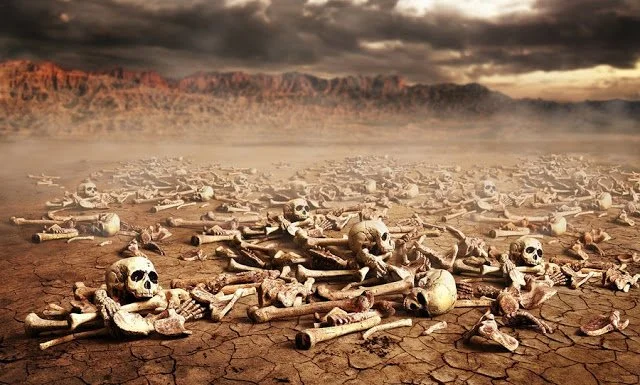
It stretches out before the prophet—bleached, barren, filled with bones. Not just a few scattered remains, but an entire field of them. The aftermath of loss. The evidence of defeat. The unmistakable sign that whatever life once was here is now long gone.
And into that silence, God asks a question: “Mortal, can these bones live?”
It is not just a question for Ezekiel. It is a question for us.
Because as we come to this fifth and final Sunday in Lent, we have been walking, week by week, deeper into the mystery of who Jesus is.
With Nicodemus, we were invited into the mystery of new birth—of being born from above.
With the Samaritan woman, we encountered the living water that quenches a deeper thirst.
With the man born blind, we saw how Jesus opens our eyes—not only to sight, but to truth.
And now, today, we stand before the most final, most immovable reality of all, the final frontier: death.
Not metaphorical death. Not spiritual dryness alone. But real, physical, undeniable death.
And here—here in the raising of Lazarus—Jesus confronts our greatest fear, and the great unknown that lies beyond it.
The story in John’s Gospel begins with a message: “Lord, he whom you love is ill.”
It is a message full of urgency, full of hope, full of trust.
But Jesus does not rush.
He waits.
And by the time he arrives in Bethany, Lazarus has been dead for four days.
Four days. Long enough that hope has faded. Long enough that grief has settled in. Long enough that everyone knows: this is over.
Martha meets him first. And her words carry both faith and heartbreak, words drenched in grief and despair:
“Lord, if you had been here, my brother would not have died.”
Mary says the same.
It is the cry of every grieving heart.
If only…
If only things had been different.
If only God had acted sooner.
If only death had not had the final word.
And Jesus does not dismiss their grief.
He does not correct their theology.
He does not offer easy answers.
He weeps.
Shortest verse in all of Scripture, and yet perhaps one of the most profound: “Jesus wept.”
Before he reveals his power over death, Jesus shares fully in the sorrow of it.
He stands with us at the graveside.
He feels the weight of loss.
He enters into the silence of the valley.
It is one of the rare moments when we can see ourselves in Jesus. Sure the disciples, and the crowds, but here in his most human, we can see ourselves in Christ. And yet, this is not where the story ends.
Because standing before the tomb, Jesus says something extraordinary to Martha:
“I am the resurrection and the life.”
Not “I will be.”
Not “I bring.”
But “I am.”
All through this Lenten journey, we have been given glimpses of who Jesus is. Living water. Light of the world. The one who gives new birth.
And now, the revelation deepens: Jesus is life itself, standing in the face of death.
This is no longer about signs alone. It is about identity.
And then comes the question—the same kind of question God once asked Ezekiel in the valley of dry bones:
“Do you believe this?”
Ezekiel’s valley and Lazarus’ tomb are not so far apart.
Both are places where hope has been extinguished.
Both are places where the future seems sealed shut.
Both are places where human possibility has come to an end.
In Ezekiel’s vision, the bones are very dry. That detail matters. This is not recent loss. This is long-term desolation. Generations of despair. The people of Israel in exile, cut off, saying, “Our bones are dried up, and our hope is lost.”
And yet, God speaks.
Bone to bone, sinew to sinew, flesh to flesh—and finally breath.
“I will put my spirit within you, and you shall live.”
Life comes not from the bones themselves, but from the breath of God.
And in Bethany, something very similar happens.
Jesus stands before the sealed tomb and cries out with a loud voice:
“Lazarus, come out!”
And the dead man comes out.
Still wrapped in burial cloths. Still marked by death. But alive.
What are we to make of this?
Because if we are honest, this story is both beautiful and unsettling.
We know that Lazarus will die again. This is not the final resurrection. This is a sign—a foretaste—pointing beyond itself.
And it raises a question that sits deep within all of us:
What does it mean that Jesus has power over death… when we still experience loss?
What does it mean to believe in resurrection… when graves still exist?
This is where Psalm 130 gives us language for the space we inhabit:
“Out of the depths have I called to you, O Lord.”
Not from a place of certainty. Not from a place of triumph. But from the depths.
And yet, even there—even in that place—the psalmist says:
“I wait for the Lord, my soul waits, and in his word is my hope.”
Lent is not a season that rushes us past the reality of death. It teaches us how to wait in the midst of it.
To stand in the valley.
To stand at the tomb.
To name our grief honestly.
And still—to hope.
Because what Jesus does at Lazarus’ tomb is not just about one man.
It is a sign of what is to come.
And it is also a turning point.
From this moment on, the Gospel tells us, the authorities begin to plot Jesus’ death.
In raising Lazarus, Jesus sets in motion the events that will lead to his own crucifixion.
He calls Lazarus out of the tomb… knowing that he himself will soon enter one.
He confronts death… not from a distance, but by walking straight into it.
And this is where the story becomes deeply personal.
Because the question is no longer just about Lazarus.
It is about us.
Where are the places in our lives that feel like that valley of dry bones?
Where are the places that seem beyond hope?
Relationships that feel beyond repair.
Grief that lingers.
Fears we cannot name.
A future that feels uncertain.
Where are the tombs we have sealed shut, convinced that nothing more can be done?
Into those places, Jesus speaks.
Not always with immediate miracles.
Not always with instant answers.
But with a presence that weeps with us… and a voice that still calls us by name.
Notice something important in the story.
When Lazarus comes out of the tomb, Jesus says to those around him:
“Unbind him, and let him go.”
Resurrection is not just about coming back to life. It is about being set free.
Free from what binds us.
Free from what holds us in the grip of death—fear, despair, isolation.
And often, that unbinding happens in community.
We help one another live into the life that Christ gives.
As we stand on the edge of Holy Week, the tension is building.
We have seen who Jesus is.
We have heard his words.
We have witnessed his signs.
We have been asked, again and again: Do you believe this?
And now, we are about to follow him to Jerusalem.
To the cross.
To the tomb.
To the place where it will seem, once again, that death has won.
But today’s Gospel gives us a glimpse beyond that.
A glimpse that tells us: death does not have the final word.
Not for Lazarus.
Not for Israel in exile.
Not for us.
Because the one who stands before the tomb and calls life out of death… is the same one who will, in just a short time, rise from the grave.
So, we return to that question from the valley:
“Can these bones live?”
On our own, the answer is no.
But with God… with the breath of the Spirit… with the voice of Christ…
The answer is yes.
Yes, even here.
Yes, even now.
Yes, even in the face of death.
And so we wait.
We hope.
We listen for the voice that calls us by name.
And when it comes—whether in this life or the life to come—we trust that it will say the same thing it said to Lazarus:
Come out.
Amen.