

March 1, 2026, The Second Sunday in Lent
In this holy season of Lent, we are walking deliberately toward Jerusalem. Week by week, we move closer to the events of Holy Week—to the upper room, to Gethsemane, to the cross, and ultimately to the empty tomb. Lent is not a sprint; it is a pilgrimage. It is a season for slowing down, for reflection, for repentance, and for rediscovering what it truly means to follow Christ.
Today, we meet a man who also comes to Jesus on a journey—though his journey begins in the dark.
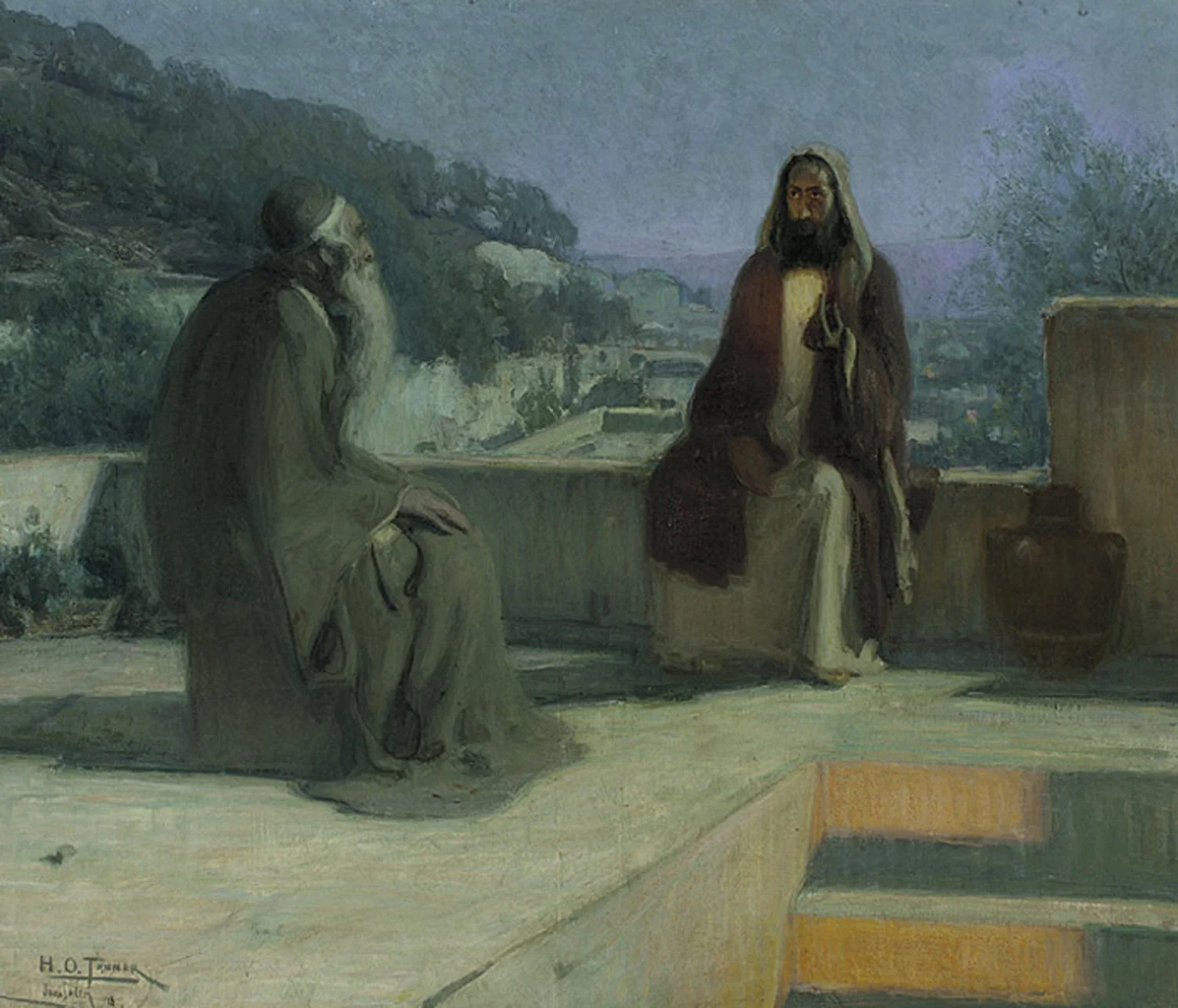
Tanner, Henry Ossawa, 1859-1937. Nicodemus, from Art in the Christian Tradition, a project of the Vanderbilt Divinity Library, Nashville, TN. https://diglib.library.vanderbilt.edu/act-imagelink.pl?RC=57924
Nicodemus comes to Jesus by night.
He is a Pharisee, a leader among the people, a teacher of Israel. He is not a villain. He is not hostile. In fact, he comes respectfully: “Rabbi, we know that you are a teacher who has come from God.” He sees something in Jesus. He senses something stirring. But he comes in the shadows.
Perhaps he comes at night because he is cautious. Perhaps he fears what others might think. Perhaps he is unsure of what he himself believes. Or perhaps night simply reflects his spiritual state: curious, thoughtful, but not yet fully in the light.
And isn’t that often how faith begins?
Not with bold declarations. Not with blazing certainty. But with questions. With quiet longing. With the sense that there must be something more.
Nicodemus comes with polite theological language. Jesus answers with a spiritual earthquake.
“Very truly, I tell you, no one can see the kingdom of God without being born from above.”
Born from above. Born again.
Nicodemus hears it literally. “How can anyone be born after having grown old? Can one enter a second time into the mother’s womb?” He is thinking in terms of biology. Jesus is speaking of transformation.
This is the heart of Lent.
Lent is not about minor adjustments. It is not about polishing up our religious habits. It is not about spiritual cosmetics. Lent invites us into something far deeper: rebirth.
To be born “from above” is to receive life as a gift, not as an achievement. It is to recognize that we cannot manufacture the kingdom of God through effort alone. It is to surrender control and allow the Spirit to move.
“The wind blows where it chooses,” Jesus says. “You hear the sound of it, but you do not know where it comes from or where it goes.”
The word for “wind” and “spirit” is the same. The Spirit moves freely. Unpredictably. Powerfully.
We do not control the Spirit. We receive the Spirit.
And that can be unsettling—especially for someone like Nicodemus, a religious leader accustomed to order, law, and structure. Yet Jesus tells him that entry into God’s kingdom is not about mastering religious systems. It is about being remade.
Lent asks us the same question: Are we willing to be remade?
Are we willing to let go of the illusion that we can save ourselves? Are we willing to allow God to do something new within us?
Because rebirth requires surrender.
Jesus then draws on a strange image from Israel’s history: Moses lifting up the serpent in the wilderness. When the people were dying from venomous bites, Moses lifted up a bronze serpent, and those who looked upon it lived.
“So must the Son of Man be lifted up,” Jesus says, “that whoever believes in him may have eternal life.”
Already, in the quiet of this nighttime conversation, the shadow of the cross appears.
To be “lifted up” in John’s Gospel means both crucifixion and exaltation. The cross will look like defeat. It will look like darkness. But it will be the very place where healing is offered.
And then we hear words so familiar that they risk losing their power:
“For God so loved the world that he gave his only Son, so that everyone who believes in him may not perish but may have eternal life.”
Notice what it does not say.
It does not say God so loved the righteous.
It does not say God so loved the certain.
It does not say God so loved those who have everything figured out.
It says God so loved the world.
The world in all its confusion. The world in its rebellion. The world in its violence and brokenness. The world that often prefers darkness to light.
God loves that world.
God loves us.
And not with vague sentimentality. But with self-giving action. God gives. God sends. God enters our condition.
“Indeed, God did not send the Son into the world to condemn the world, but in order that the world might be saved through him.”
That is astonishing.
Nicodemus likely expects judgment language. After all, he knows the prophets. He knows the warnings. But Jesus speaks of salvation.
This does not mean there is no accountability. Light does expose darkness. Truth does reveal what is hidden. But the purpose of Christ’s coming is rescue, not rejection.
Lent, then, is not a season of self-condemnation. It is a season of honest self-examination in the presence of love.
There is a difference.
Self-condemnation says: “I am hopeless.”
The Gospel says: “I am loved, and therefore I can change.”
Self-condemnation paralyzes.
Grace transforms.
Nicodemus comes in the night. But the conversation is full of light.
Later in John’s Gospel, Nicodemus will appear again—defending Jesus cautiously before other leaders, and finally helping to prepare Jesus’ body for burial. His journey unfolds slowly. Quietly. Faith growing in stages.
Perhaps that gives us hope.
Not all faith journeys are dramatic. Not all conversions are instant. Some of us come by night, again and again, bringing our questions, our doubts, our half-formed prayers.
Lent gives us permission to do exactly that.
To come honestly.
To come humbly.
To come seeking new birth.
As we continue our journey toward Holy Week, this passage asks us to consider three invitations.
First, the invitation to honesty.
Nicodemus does not pretend he has no questions. He comes seeking. Lent invites us to name what is unsettled in us. Where are we spiritually restless? Where are we resistant? Where do we prefer the safety of the night to the vulnerability of the light?
Second, the invitation to surrender.
We cannot engineer rebirth. We cannot force the Spirit. We can only open ourselves in trust. What would it look like for you, this Lent, to let the Spirit move freely in one area of your life you have kept tightly controlled?

Third, the invitation to trust love.
At the center of this passage stands not a command, but a declaration: God so loved the world.
Before we fast.
Before we pray.
Before we repent.
We are loved.
And because we are loved, we are free to step into the light.
The cross toward which we are walking is not a symbol of divine anger unleashed upon a helpless world. It is the sign of divine love entering the deepest darkness.
Nicodemus begins in the night. But the Gospel of John ends in a garden at dawn.
Light breaks in.
And that is our destination too.
As we continue through Lent, may we have the courage of Nicodemus—to come, even if it is by night. May we have the humility to be born from above. And may we rest in the astonishing truth that the God who calls us into transformation is the same God who so loves the world. Amen.