

March 8, 2026, The Third Sunday in Lent
In the holy season of Lent, the Church in her wisdom gives us long Gospel readings that invite us not simply to glance at Jesus, but to linger with him. Last Sunday, in our reading from the Third Chapter of John, we met Nicodemus—a learned man, a leader of the people—who came to Jesus by night. This week, in the very next chapter, we find Jesus again in conversation—this time not with a respected teacher of Israel, but with a Samaritan woman at a well at noon.
Last week it was night; this week it is blazing midday. Last week it was a man of status; this week it is a woman on the margins. Last week the conversation unfolded in the safety of a private meeting; this week it happens in public, at a well, in disputed territory.
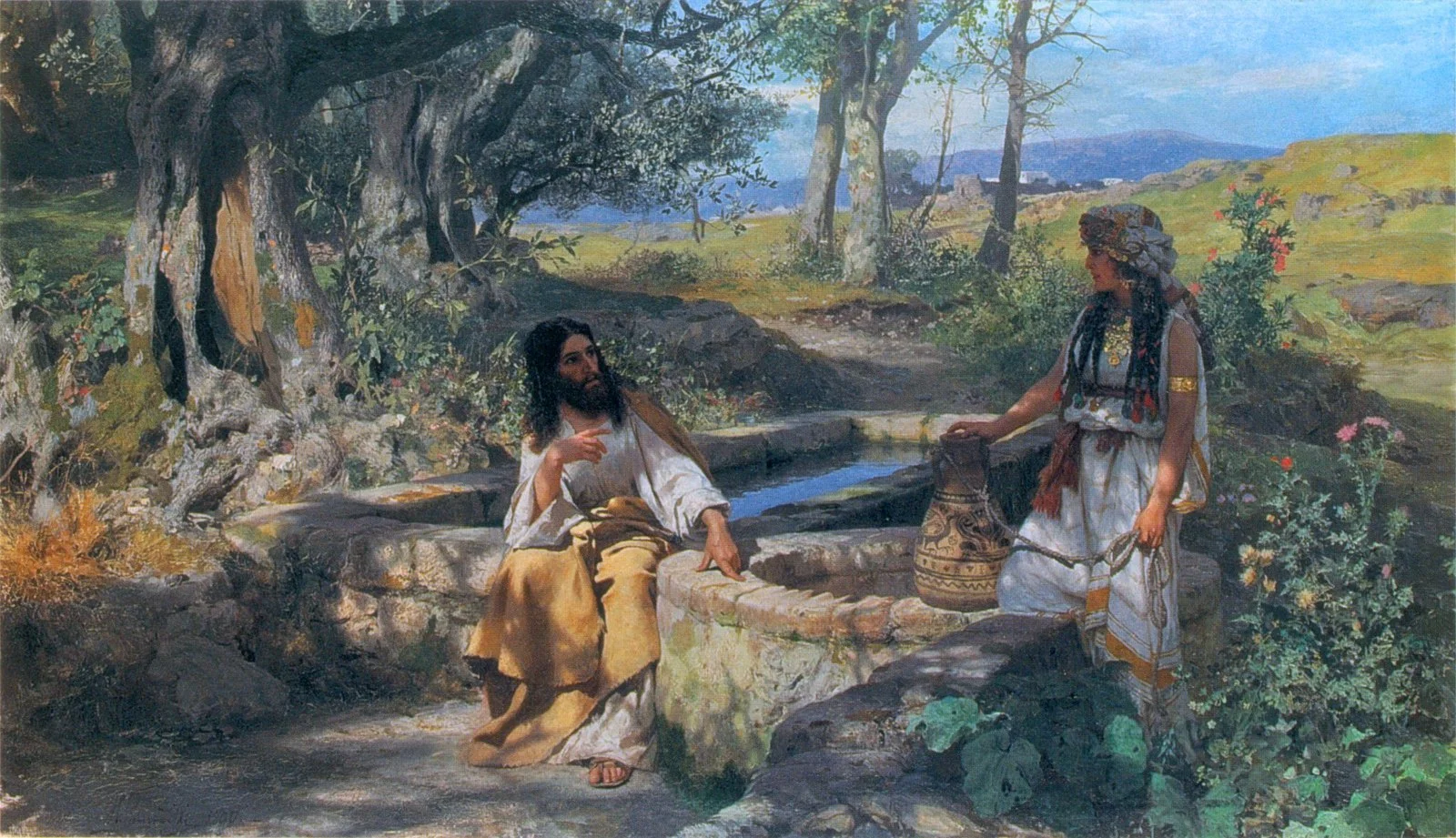
Siemiradzki, Henryk, 1843-1902. Christ and the Samaritan Woman, from Art in the Christian Tradition, a project of the Vanderbilt Divinity Library, Nashville, TN. https://diglib.library.vanderbilt.edu/act-imagelink.pl?RC=54747
Jesus leaves Judea because of tensions with the Pharisees and travels north. John tells us that “he had to go through Samaria.” Geographically, that is debatable; many Jews would have gone around Samaria to avoid contact. But spiritually, the Gospel insists: he had to go through Samaria. There is divine necessity here. Grace is on the move.
He comes to a town called Sychar, near the plot of ground that Jacob had given to his son Joseph. And there, at Jacob’s Well, weary from his journey, Jesus sits down.
It is the middle of the day, and a woman comes carrying the jar she needs for the ordinary work of life.
Already, the dynamics are complicated. Jews and Samaritans shared a common ancestry but were divided by centuries of theological and political hostility. They disagreed about the proper place of worship—Jerusalem or Mount Gerizim. They distrusted one another. And there are also the dynamics of gender and reputation. A Jewish man does not casually address a Samaritan woman in public.
Yet Jesus does.
“Give me a drink,” he says.
The Creator of living water asks for a cup.
Last week, Jesus told Nicodemus, “You must be born from above.” Nicodemus struggled to understand. Now Jesus speaks of “living water.” The woman misunderstands too. She thinks he means fresh, flowing water—better than the still water of a well. “Sir, you have no bucket, and the well is deep.”
John’s Gospel delights in this kind of holy misunderstanding. People hear Jesus on one level while he is speaking on another. Nicodemus thought of physical birth; Jesus spoke of the Spirit. The woman thinks of plumbing; Jesus speaks of eternal life.
But notice the difference. Nicodemus retreats into confusion. The woman presses in with questions. She engages. She challenges.
“Are you greater than our ancestor Jacob?”
She names the well’s history. She claims her place in the story.
Then the conversation turns, uncomfortably, to her personal life.
“Go, call your husband.”
She replies, “I have no husband.”
Jesus reveals that he knows her story: five husbands, and the man she now has is not her husband.
This moment has often been read as moral condemnation. But the text does not say that Jesus shames her. It does not say she is immoral. In the ancient world, women rarely initiated divorce. She may have been widowed multiple times. She may have been abandoned. Her life may be marked not by scandal but by sorrow.
What matters is this: Jesus sees her. Fully and completely. He names her truth, and she is not destroyed by it.
Last week, Jesus told Nicodemus that “the light has come into the world.” Here, in the bright light of noon, this woman stands in that light—and she does not flee.
Instead, she shifts the conversation to worship.
“Our ancestors worshiped on this mountain, but you say that the place where people must worship is in Jerusalem.”
Jerusalem—the heart of Jewish worship, the place toward which our Lenten journey is now turning. We are walking with Jesus toward that city, toward confrontation, toward the cross.
But here, in Samaria, Jesus says something astonishing:
“The hour is coming when you will worship the Father neither on this mountain nor in Jerusalem… the true worshipers will worship in spirit and truth.”
The hour is coming.
In John’s Gospel, “the hour” always points toward the cross—toward Holy Week, toward the moment when Jesus will be lifted up.
Worship in spirit and truth is not about geography. It is about relationship. It is about hearts laid bare before God. It is about the kind of honesty this woman embodies: “I have no husband.”
No pretense. No religious performance. Just truth.
Then comes a remarkable moment. The woman says, “I know that Messiah is coming.”
And Jesus replies, “I am he.”
To Nicodemus, Jesus spoke in riddles. To the religious authorities, he often spoke obliquely. But to this Samaritan woman—this outsider—he offers a clear self-revelation.
Perhaps because she is ready to receive it. Perhaps because those who know their thirst are closest to living water.
She leaves her water jar behind.
That detail matters. The jar is why she came. It represents her daily burden, her routine, her survival. She leaves it because she has found something greater.
She runs back to the town and says, “Come and see a man who told me everything I have ever done! He cannot be the Messiah, can he?”
This is evangelism at its most authentic. Not a polished argument. Not a theological treatise.
Just an invitation: Come and see.
Last week, Nicodemus came to see Jesus. Today, the Samaritan woman becomes the one who invites others to come and see. The seeker becomes the witness.
And the townspeople come. They listen. They ask Jesus to stay. Many believe because of his word.
And they say to the woman, “It is no longer because of what you said that we believe, for we have heard for ourselves.”
The circle widens.
As we move deeper into Lent, these two stories—Nicodemus and the Samaritan woman—prepare us for Holy Week in different but complementary ways.
Nicodemus represents the careful, cautious disciple. He comes at night. His faith grows slowly, in the shadows.
The Samaritan woman represents the bold response. She encounters Jesus in the heat of the day and becomes a herald.
Both journeys are real.
Both are welcome.
And both are drawn toward the same hour—the hour when Jesus will be lifted up, when living water will flow from his pierced side, when the love of God will be poured out not for one people, but for the whole world.
Lent is the season when we allow Jesus to cross into the disputed territories of our own lives—the places we avoid, the truths we would rather not name.
He sits beside the deep wells of our history and says, “Give me a drink.”
He makes himself vulnerable. He asks something of us. And in that asking, he offers everything.
But we know where this journey leads.
Beyond the cross.
Beyond the sealed tomb.
To the morning of the Empty Tomb—
where death is undone
and love prevails.
The living water offered at Jacob’s Well will not be stopped by a stone rolled across a grave.
It will rise.
It will flow.
It will reach Samaritans and Pharisees,
cautious seekers and bold proclaimers.
It will reach us.
So this Lent, may we dare to be honest about our thirst.
May we allow ourselves to be seen and known.
Like the woman at the well, we may find that the things we came carrying—the jars of our routines, our worries, our old stories—are no longer what we need most. For when we encounter Christ, we discover something greater than the water we came to draw.
And may we hear again the invitation of Christ:
“Come and see.”
For the hour is coming—and has now come—when the true worshipers will worship the Father in spirit and truth.
Where the love of God prevails.
Thanks be to God.