
August 23, 2026, The Thirteenth Sunday after Pentecost
Who do we say we are?
Romans 12:1-8, Matthew 16:13-20
The gospel for today continues to take us on the road with Jesus.
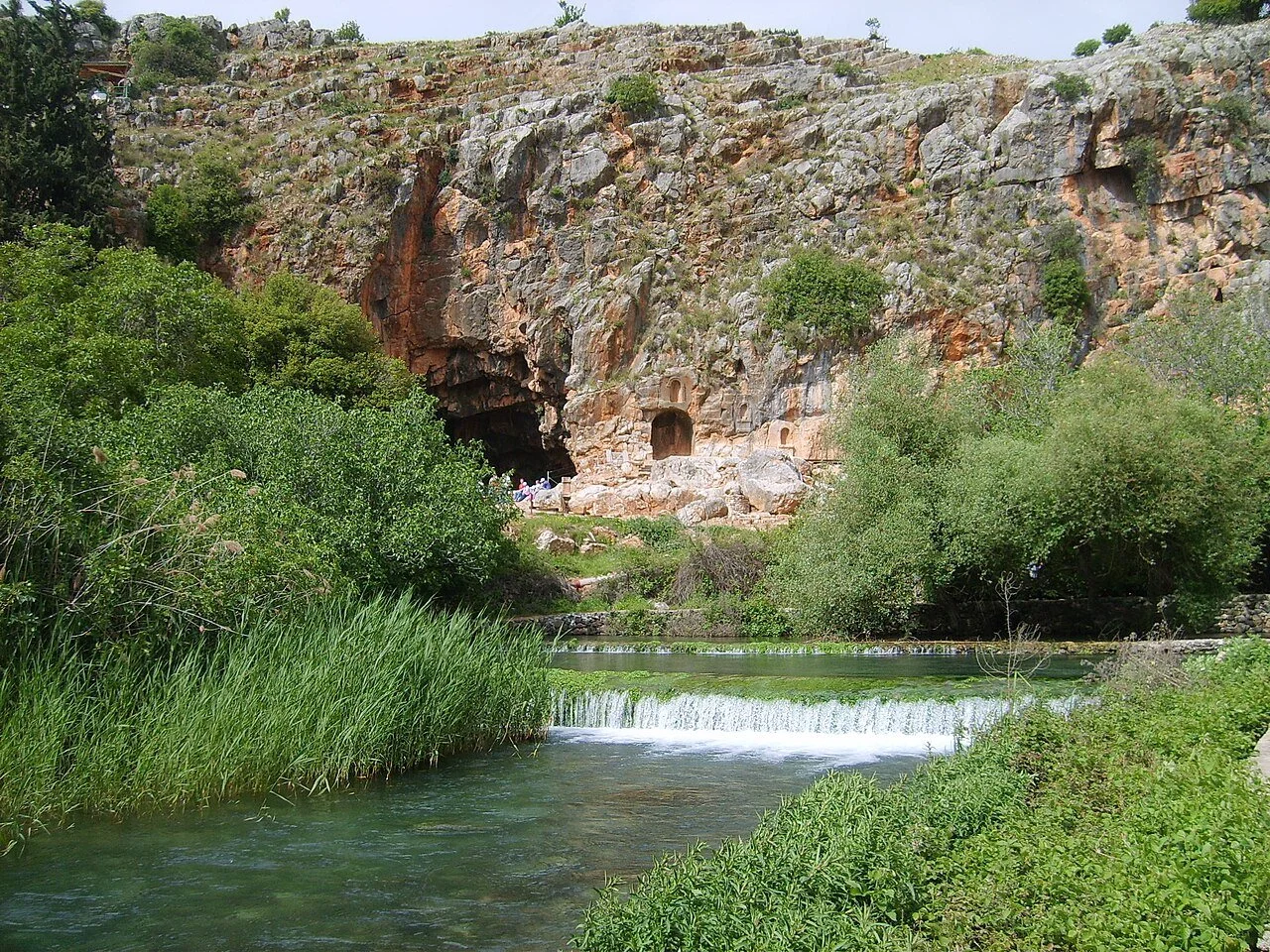
The spring of Banias with the Cave of Pan in background.
By gugganij - Own work, CC BY-SA 3.0, https://commons.wikimedia.org/w/index.php?curid=3992796
Last week, he was traveling north outside the traditional borders of ancient Israel in the cities of Tyre and Sidon, among Gentiles. Now he is still far from Jerusalem, in the northern city of Caesarea Philippi, in what is today known as the Golan Heights. It is one of my favourite gospel scenes, partly because I have been there. I can still picture the rugged landscape, the lush trees, and the water flowing down from Mount Hermon toward the Sea of Galilee.
But the setting matters for more than its beauty. Caesarea Philippi was a place of competing religious claims. There were shrines to various Roman gods, a temple built by Herod the Great honouring his patron Caesar Augustus, and the great cave dedicated to Pan, a half man, half goat deity whose virtues and vices would become associated with the Devil. In a landscape filled with claims about power, worship, and salvation, Jesus asks his disciples a simple but searching question: “Who do people say that the Son of Man is?”
From the start, Matthew wants us to hear that this scene is about identity, so the disciples give the expected answers. Some say John the Baptist. Others say Elijah. Others Jeremiah. In Jesus’ time, many people looked to the great prophets of the past: the ones who performed mighty deeds, challenged kings, and spoke God’s words of judgment, opposition, and hope. Some saw John the Baptist as the latest in that long line of messengers. Others reached further back to figures like Jeremiah. But Jesus’ question presses beyond those inherited categories.
And then Jesus turns the question on its head and directs it toward them: “But who do you say that I am?” I absolutely love that question…”But who do you say that I am?”
Peter, who so often misunderstands, gets it exactly right: “You are the Messiah, the Son of the living God.” Peter has followed Jesus. He has listened to him. He has watched him. And through Jesus’ words and actions, Peter has seen who Jesus truly is.
Peter’s confession matters. He names Jesus as the Messiah, the Son of the living God. In Jesus, we find salvation. In Jesus, we find reconciliation. And a living God is not static. God’s clearest word was not spoken only in the past. In Jesus, God continues to speak. God continues to act. God continues to create and anoint. God does not need to bring back John the Baptist, Elijah, Jeremiah, or any other prophet in order to be heard. In Jesus, God is revealing himself in a radically new way.
And as I sat by those clear pools and streams—the waters that eventually become the Jordan River—I found myself sitting with Jesus’ question: “Who do you say that I am?” And I began to ask myself how I identify Jesus from my own experience.
For me, Jesus is redeemer. No matter how many mistakes I have made—or will make—there is forgiveness. There is mercy. There is a welcome home, like the Prodigal Son. So I keep striving to become the person God has called me to be. Not because I am perfect. Not because I am expected to be. But because I am loved.
For me, Jesus is healer. I have been open about my clinical depression, and about the darkness I once lived through. In those years, there was a voice pulling at my heart and mind. A voice keeping me from the edge of the abyss. A voice assuring me that there was more to life than what I was feeling.
For me, Jesus is teacher. Growing up in the Church and in the Boy Scouts, I learned about selfless servant leadership. I learned about giving of myself. Offering my gifts. Serving the world around me. My faith formation has helped shape the person I am today.
And that led me to another question. What marks my identity in Christ? Who do I say that I am? Names came to mind: son, brother, friend. Words came to mind: compassionate, generous, resolute. Some parts of me remain constant. Others are still shifting. Still transforming. Still growing into the fullness God desires for me. I am not a static person, forever stuck in one way of being. I am a person being transformed—from glory into glory.
We gather here every week as a community bound together by our common life and by our shared confession of Jesus as the Christ. The Messiah. Our Savior and Redeemer. In our affirmation of faith, we acknowledge that the way, the truth, and the life are rooted in mercy, love, and forgiveness—for others, and for ourselves. So yes, we stand with Peter and confess our faith in Jesus. But the question also turns inward: “Who do you say you are?”
That question matters. It matters now, just as much as it mattered then. Who do we say that we are—as individuals, and as a parish? How do our lives reflect the mercy and love of God? How do we make room for God’s will, and not only our own?
As we move toward the beginning of a new program year here at All Saints, we return to that same simple question: “Who do you say you are?” Paul reminds us that the body has many members, and not all members have the same function. So we, who are many, are one body in Christ. And individually, we are members one of another. We all have a place in this Body. Each of us has a role as a living member of the Body of Christ.
Here at All Saints, there are opportunities to offer your gifts and talents. We are stakeholders in this community of faith. We are called to be agents of life and transformation. Each of you has a place in this parish. Each of you has a role to play in its life. There are many ways to serve and become more deeply engaged. Perhaps it means trying a new ministry like singing in the choir or hospitality. Perhaps it means getting involved in one of our outreach projects. Perhaps it means becoming a sides-person, helping to welcome people to our services.
And our common life is not only about how we serve. It is also about how we pray. How we worship. How we allow God to renew our minds and hearts, so that we may discern the will of God for us and this parish. Perhaps this is the season to try a new discipline of prayer. Perhaps it is the season to join us on Wednesdays for our mid-week service. Perhaps it is the season to step forward in service, to risk something new, to discover again what part of the Body God is calling you to be. We need action, and we need contemplation. We need courage, and we need stillness. So let us not leave Jesus’ question at Caesarea Philippi. Let us carry it with us. Into our homes. Into our work. Into this parish. Into the life God is calling us to share. Who do you say that you are? What is your identity in Christ? And what ministry is God placing in your hands?
May the faith we confess with our lips take root in our hearts, take shape in our lives, and become the work of love in our hands. Amen.