

August 16, 2026, The Twelfth Sunday after Pentecost
The Tradition That Leads Us to Love
Romans 11:1–2a, 29–32; Matthew 15:10–28
There is something deeply human about the things we do again and again. We light candles. We stand, sit, kneel, and sing familiar hymns. We make the sign of the cross. We baptize with water. We break bread together. We learn prayers that have been carried by Christians for generations.
There is real beauty in this. Ritual gives shape to faith. Tradition gives us language for what is often too deep for ordinary speech. These patterns gather us into community and remind us that we belong to something larger than ourselves.
But there is also a danger. The very things that open a doorway into the presence of God can become a wall between us and God, and between us and our neighbours. That tension sits near the heart of today’s Gospel, where Jesus says, “It is not what goes into the mouth that defiles; but it is what comes out of the mouth.”
The issue is not simply food. It is about who gets judged clean or unclean, acceptable or unacceptable, inside or outside the community.

I can still remember my days on my elementary school playground as we all lined up to be picked for what ever game we were playing that recess. As each kid is picked, before long you can’t help but wonder, why not me? What on my outside, my size, my athletic ability, or just because someone doesn’t like me caused me and others to be picked last? Why was I being judged on only what can be seen, and not for the enduring qualities of my character that go unseen? As Heidi Klum says in Project Runway, “one day you are in, and the next you are out.” These are the rules the world plays by again and again.
The traditions and laws of ancient Israel were not arbitrary. They helped God’s people understand who they were and ordered their lives around God. Tradition can do that for us, too. Christianity is not something we invented this morning; it is something we have received.
And that inheritance is precious. When we grieve, the Church gives us prayers. When we rejoice, it gives us songs. When we are uncertain, worship reminds us that God’s faithfulness does not depend on our ability to feel faithful.
Tradition can be a conduit for grace, but it is not the destination. Ritual is meant to lead us toward God, form us in love, and help us recognize the image of God in another human being.
Whenever our traditions become tools for deciding who belongs and who does not, we need to ask whether we have forgotten their purpose.
That question becomes concrete in the encounter between Jesus and the Canaanite woman. She comes crying out, “Have mercy on me, Lord, Son of David; my daughter is tormented by a demon.” At first, Jesus does not answer. The disciples are irritated: “Send her away.”
She is an outsider, beyond the boundaries of ancient Israel’s religious community. Yet she will not go away. She kneels before Jesus and says, simply, “Lord, help me.”
Jesus responds with words that are difficult for us to hear: “It is not fair to take the children’s food and throw it to the dogs.” But she quickly retorts, “Yes, Lord, yet even the dogs eat the crumbs that fall from their masters’ table.”
And as we just heard, Jesus says, “Woman, great is your faith!” Her daughter is healed.
This story unsettles us because the outsider recognizes what the insiders struggle to see: God’s mercy is larger than the boundaries people have drawn around it.
Sometimes the person we have placed outside the circle becomes the one through whom God teaches us what the circle was meant to be.
Paul is wrestling with a related question in Romans: if God’s mercy is wider than human boundaries, what does that mean for ancient Israel and for the promises God has made? Has God abandoned ancient Israel? Has God’s promise failed? His answer is emphatic: “By no means!” “The gifts and the calling of God are irrevocable.”
God is not a God who casually throws people away. God’s covenant is not a membership card to be cancelled when someone fails to meet our expectations.
Paul concludes that God has “imprisoned all in disobedience so that he may be merciful to all.” Mercy is the great leveller. All of us stand before God in need. None of us can use religion as a ladder to climb above someone else.
This matters especially for those of us who love the Church. We should love its prayers, music, sacraments, seasons, and inherited wisdom. But we must always remember what they are for.
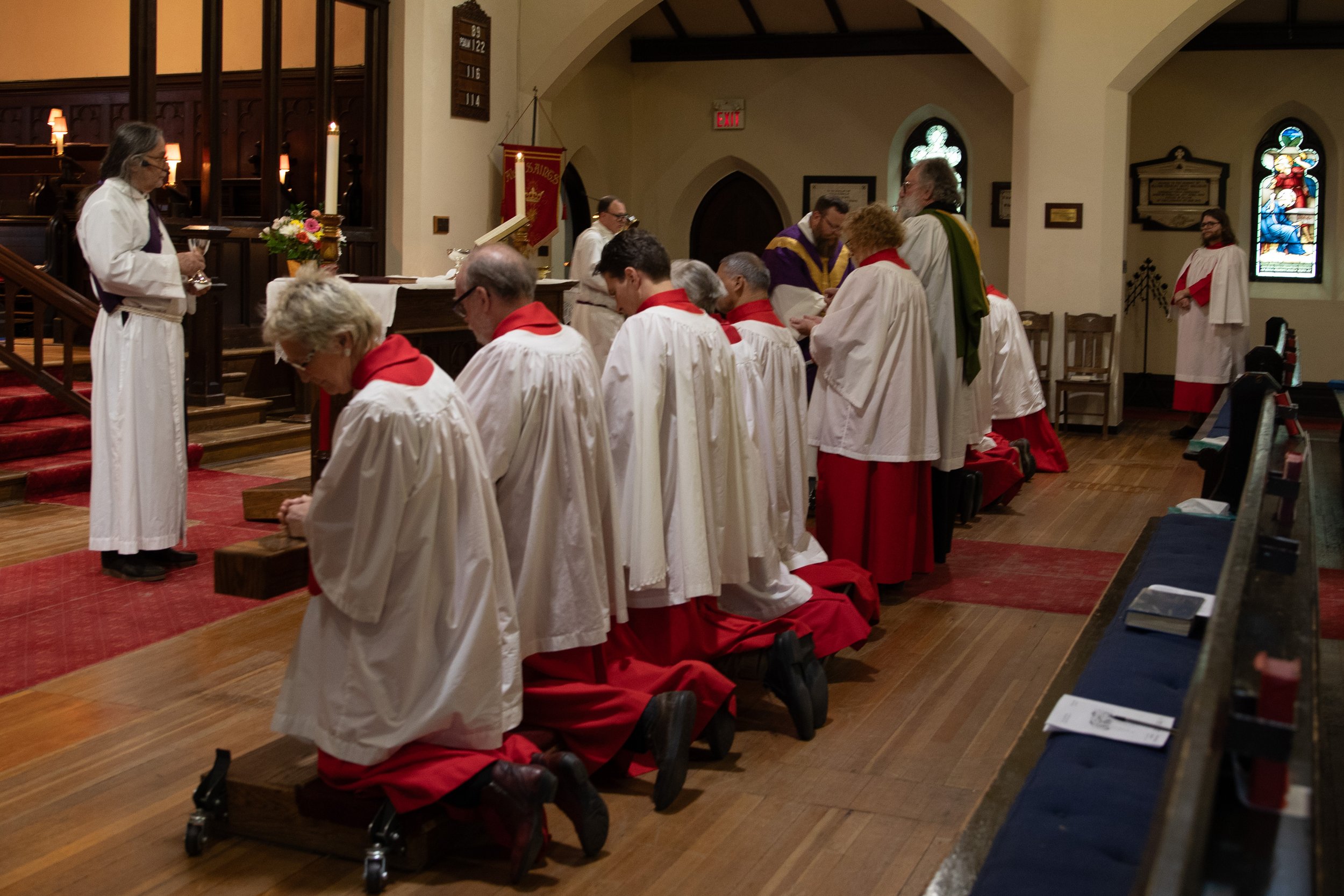
We do not gather on Sunday merely to perform a beautiful ritual. We gather because God calls us into relationship. We kneel to learn humility. We confess to learn honesty. We receive Communion to learn that God’s life is gift. We come here again and again to be transformed. This is something that we will explore more deeply in the Fall.
We keep tradition not because God needs it, but because we need physical and spiritual practices that help us remember who God is and who we are. If those practices make us proud, judgmental, or inhospitable, something has gone wrong.
So, the deepest question is not only, “Are we doing the tradition correctly?” We must also ask, “What is this tradition forming us to become?” Is it making us more compassionate, patient, generous, and ready to welcome the person who does not know the rules?
If the answer is yes, then tradition is doing what it was meant to do: becoming a conduit of God’s grace. But if it becomes a reason to say, “You don’t belong here,” then we have turned a doorway into a wall.
The Canaanite woman reminds us that God’s mercy is larger than our categories. She comes from outside the boundaries and refuses to let those boundaries have the final word. In this encounter, faith appears where others least expect it.
And that is a word the Church always needs to hear. Every congregation has boundaries. Some are necessary: communities need practices, patterns, beliefs, and a common life. But boundaries must never become more important than the people they are meant to serve.
The purpose of Christian tradition is not to preserve a museum. It is to form a people capable of loving God and loving neighbour. Worship does not simply remember the past; it makes us available to the living God in the present.
Our rituals do not convince God that we belong. They remind us that, before we ever did anything to deserve it, God had already claimed us as beloved.
Ad it is here is where the readings meet: Paul says God’s gifts and calling are irrevocable, and Jesus encounters a woman who refuses to believe that mercy runs out at the edge of the boundary. Both point us toward the same astonishing truth:
God's mercy is bigger than our boundaries.
So let us treasure our traditions: praying the prayers, singing the hymns, keeping the seasons, coming faithfully to the Eucharistic table, and cherishing the inheritance we have received like this beautiful sacred space.
But let us do all of this with open hearts. The tradition we have received is not about protecting ourselves from the world. It is about becoming people through whom God’s love can enter the world.
May our rituals lead us into relationship. May our traditions lead us into love. May our worship make us more welcoming, not less. And when someone comes from outside our familiar boundaries and cries, “Lord, help me,” may we have grace to recognize what the Canaanite woman knew:
There is always more mercy at God’s table than we imagined. Amen.