

Sustaining the Family of the Son of Man
By Dr. Melanie Lewis
In our cultural imagination, we are already living in an eschatological age, an age at the end of life as we know it, with hinges to the apocalyptic and post-apocalyptic. Evidence abounds in films, books, and games.
And no wonder: Our society at large is feverish: Several studies state that between 15 and 20% of Americans and Canadians over twelve are suffering from substance use disorder; and according to a Pew Research Study from 2024, 45% of American youth aged 13-17 say they are addicted to internet use. Our planet has a fever: That eminent eco-scientist, David Attenborough of The Planet Earth series, has been reporting on climate change for decades. In 2024 he warned us about the distribution of land mammals on Earth: 35% are human, about 61% are animals domesticated for human use; and 4% are mammals living in the wild. The greatest driver of habitat loss is clearing for raising beef cattle. Even if these statistics are off by several points—and they may well be—the trends they represent are gravely disturbing.
Today we have come to Matthew’s last parable of the eschaton before the passion of Christ. The Ruler calls on us the feed the hungry, clothe the naked, and visit the sick and imprisoned. Literally: Do this. And also, by extension, to sustain those overcome by addiction—for they are always hungry and can never be satisfied. And by extension also, I would suggest, the ruler calls on us to preserve the earth. Because a dying world where we seek without finding that rare flying creature, those graceful legs that move through the vanishing forest, the one whose plash recedes behind the boat—that dying world we are now bequeathing to the future will already be a prison.
Like most parables, the parable for this Sunday foregrounds surprise. A surprise that would perhaps strike stronger during the time of Jesus, when goats and sheep, their hides, meat, and milk, were equally important to the economy and when consigning either to punishment appears peculiar. But much more striking is the surprise both of the righteous and the accursed. The righteous will answer the king and say, Lord, when was it that we saw you hungry and gave you food, sick or imprisoned and visited you? Almost in a tone of complaint, as though the Son of Man owed it to them to appear. And the goats also will answer, Lord, when was it that we saw you hungry, naked, or in prison, and did not take care of you? How is it that neither group has recognized the Son of Man in the least of his family?
Such surprise demonstrates how impossible it is to calculate our chances of earning a place among the righteous. “I give here, we serve there; how many times, before I am counted among the sheep?” The righteousness that belongs to the rulership of Christ exceeds what can be calculated. But we can trust that in the kingdom of heaven, the wants of the least of these will take precedence. For the Son of Man on his throne of glory, says the preacher, identifies their wants as coinciding with his own, as if he shares his very body with theirs.
And Jesus, preaching in parables in the time leading up to his passion, demonstrates that the matter is of the utmost importance. In Galilee in the time of Jesus, the reigns of the Herods, those client kings of the Roman Empire, had impoverished the people. Herod the Great slaughtered the innocents and carried out massive building schemes. Herod Antipas, the king of the time of the parable, brought up at the court of Caesar Augustus, also had luxurious tastes. In order to support their lifestyles, the peasants, tradespeople, and fisher-folk of Galilee were taxed by the Herods to the breaking point. Many starved; many were imprisoned for debt, or sold themselves into slavery.
But in the kingdom of heaven, the least of us, the lowest on the social ladder, on the political ladder, are being freed from hunger and the degradation of severe poverty, and are being redeemed from slavery. We can trust that the building of the kingdom calls not only for the giving of alms, but, more radically, for social and political change, so that the lifestyles of the politically powerful will not reduce the rest to indebtedness and slavery.
The surprise both the righteous and the accursed show, their cluelessness in a way, suggests that whether goat or sheep, we can’t calculate our way into eternal life, whatever that might mean for us. And it’s clear that we don’t enter it patting ourselves on the back for belonging to the right religious group.
If you look at your bulletin cover, you can see from this print of the painting by Hans Memling the face of a somewhat withdrawn Christ of gentle demeanour, holding the orb that signifies his rulership and raising his hand in a gesture of blessing. The impression is one of gentleness and stillness, Christ listening to the music of the angels, with a face perhaps ironically at odds with the regalia he wears. I invite you to telescope your vision out from the plane of the painting, and to imagine that we are standing with rank upon rank
of πάντα τά έθνη, panta ta ethne, in Greek, all the ethnicities, all the nations, gathered before Christ, looking up at him. The Son of Man in today’s parable addresses all the nations. Not only Christians or Jews but Jains, Buddhists, agnostics, traditional aboriginals, all apparently have the capacity to further or hinder the building of the kingdom of heaven. So, another surprise: We cannot assume we know the exact shape of the communities who are prioritizing the needs of the least of us.
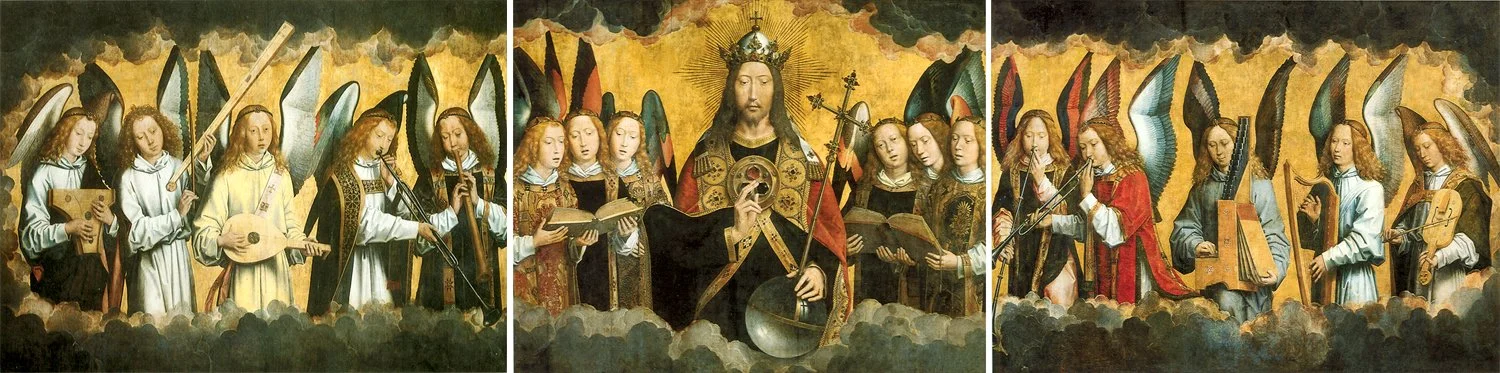
By Hans Memling - www.aiwaz.net, Public Domain, https://commons.wikimedia.org/wiki/Special:Redirect/page/17261190
So the parable not only exhorts us to show mercy without entering into a calculation of the nature of the reward; it also evokes humility as the response to the Son of Man before the nations.
Standing at the precipice of the eschaton, of the fast-approaching ending of life as we know it, how can we hear the parable as Good News? Well: the parable opens onto another teaching of Jesus from the Gospel of Matthew: “Whatever you bind on earth, will be bound in heaven, and whatever you loose on earth, will be loosed in heaven.” That the kingdom of heaven will be inaugurated in its fulness we are glad to believe; what exactly will be saved, whose life, whose dreams, whose capacities, which species, and which ecosystems will survive into God’s future and our own, depends on us and our co-building. Only to those able to respond are such responsibilities given.
This last parable of the eschaton invites us to live in creative tension within a reign that grants abundance and freedom to the impoverished, the marginalized, the enslaved; and that at the same time calls for a certain toleration of emptiness.
Perhaps, before reaching for whatever substance, activity, or behaviour pattern that will give us a zing of dopamine, or that drive lifestyles that are damaging the world, we might tolerate a space of emptiness for a time. A practice of making space, that, to quote the Russian poet Michael Lermontov, is not filled with the desire for eternal life, or with gratitude for having been saved from the battlefield, or repentance, or a plea for the forgiveness of sin; but a space where, without words, we offer, merely, offer ourselves. And as God grants, the mercy and humility that characterize the kingdom of heaven will attune us, re-tune us to our purposes in contributing to build it. May God grant it. Amen.