

December 28, 2025, The First Sunday after Christmas
Christmas is barely behind us. The candles are still glowing. The carols still echo in our ears. We are still lingering at the manger, still holding close the wonder of angels and shepherds, of heaven touching earth in the fragile body of a child.
And then the lectionary does something rather startling.
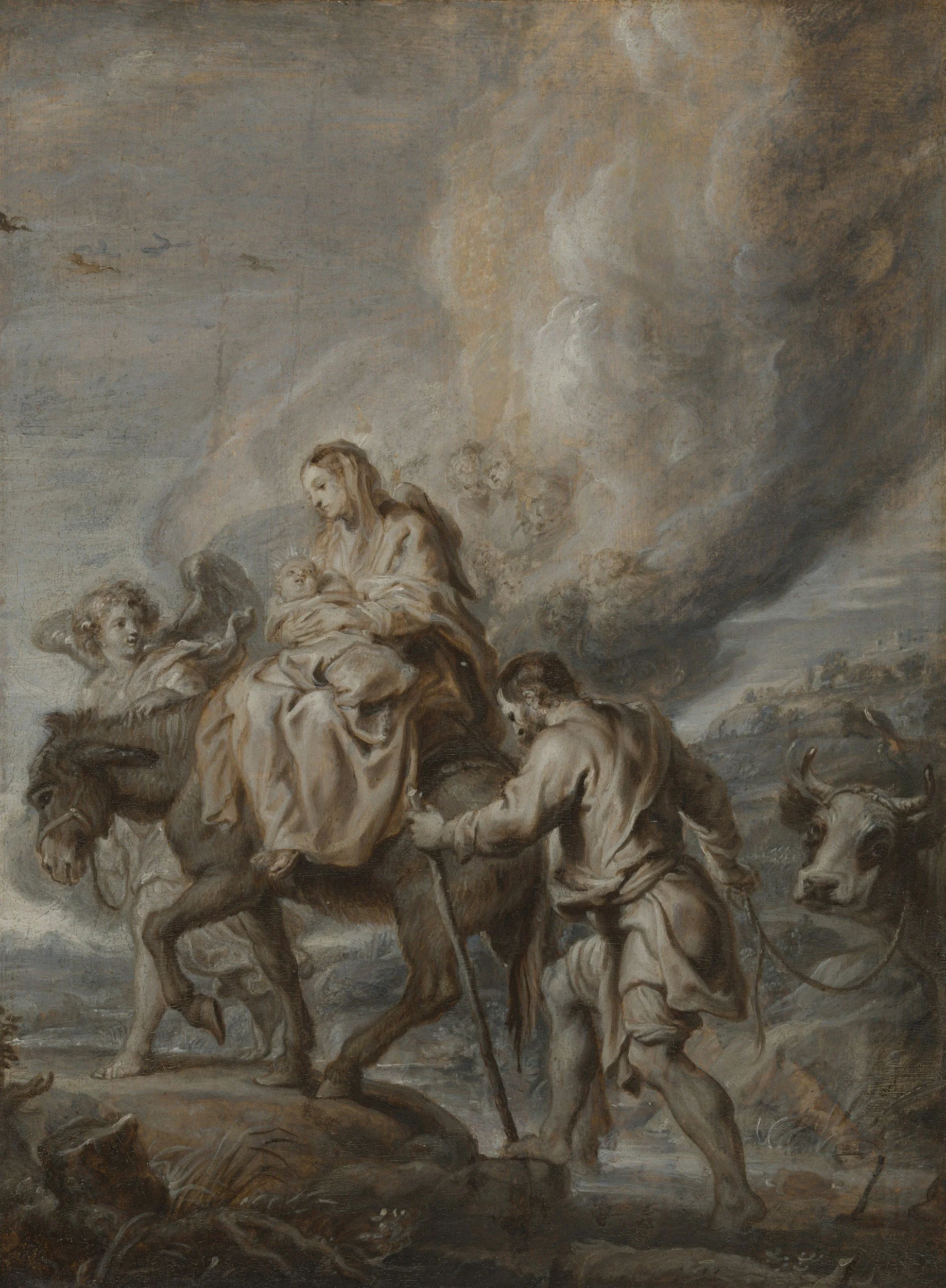
Just as we are settling into the warmth and sweetness of Christmas, the Church gives us this story: a holy family fleeing in the night, a tyrant’s rage, children slaughtered, parents wailing, and a refugee child carried across a border for his life.
This is not the scene we expect so soon after “Silent Night.”
And yet—this is precisely the story we are given.
Because the Church knows something important: Christmas is not sentimental. The incarnation does not float above the world’s pain. God does not arrive in safety, but in vulnerability. The Word becomes flesh not in spite of the darkness, but in the midst of it.
Matthew tells us that after the visit of the Magi, an angel appears to Joseph in a dream and says, “Get up, take the child and his mother, and flee to Egypt… for Herod is about to search for the child, to destroy him.”
The child we have just celebrated is already marked for death.
Joseph obeys without hesitation. He rises in the night. No time to prepare. No time to explain. No time even to say goodbye. Mary gathers what she can. They take the child and flee into Egypt—ironically, the very place from which Israel had once fled slavery.
Matthew tells us this is to fulfill what was spoken by the prophet: “Out of Egypt I have called my son.”
But there is no triumph here. No singing angels. Only fear, exhaustion, and uncertainty. The Holy Family becomes refugees—dependent on the kindness of strangers, vulnerable to suspicion, living far from home.
This is not a side detail of the gospel. This is central to who Jesus is.
From the very beginning, Christ identifies not with the powerful but with the threatened. Not with the secure, but with those on the move. Not with palaces, but with those who flee them.
And then Matthew tells us what happens next. Herod, realizing he has been tricked by the Magi, lashes out in violence. He orders the killing of all the children in and around Bethlehem who are two years old and under.
It is one of the most horrifying passages in Scripture.
We are told that Rachel weeps for her children and refuses to be consoled.
The gospel does not flinch here. It does not soften the story. It does not rush us past the grief. It tells the truth: that the coming of God into the world does not magically erase human cruelty. The birth of Christ does not stop tyrants from being tyrants. It does not shield children from suffering.
And yet—this is the mystery of our faith—it is precisely here that God chooses to be present.
This is where Isaiah helps us today.
The prophet writes:
“I will recount the gracious deeds of the Lord,
the praiseworthy acts of the Lord,
because of all that the Lord has done for us…
In all their distress, he too was distressed,
and the angel of his presence saved them;
in his love and in his pity he redeemed them;
he lifted them up and carried them all the days of old.”
Did you hear that?
In all their distress, he too was distressed.
This is one of the most tender lines in all of Scripture.
God does not watch suffering from a distance. God does not stand above history untouched. God enters it. God bears it. God carries it.
In Jesus, God knows what it is to be hunted.
God knows what it is to flee.
God knows what it is to lose children to violence.
God knows what it is to weep.
The flight into Egypt tells us something essential about the nature of God’s love: it is not abstract, and it is not safe. It is embodied. It is vulnerable. It is costly.
And yet, even here, God is at work.
Herod’s violence does not have the final word. Fear does not win. Death does not get the last say. The child survives. The story continues. God’s purposes are not undone, even by the worst that human power can muster.
Matthew ends this passage quietly: after Herod’s death, Joseph is told to return. But even then, it is not simple. They cannot go back to Judea. Another ruler reigns there. So they settle in Nazareth—an unremarkable town, far from power and prestige.
This, too, matters.
Jesus grows up not in a palace, not in a center of influence, but in a place people later sneer at: “Can anything good come out of Nazareth?”
And the answer, of course, is yes.
God often chooses what the world overlooks.
So what does all of this mean for us, here, in the days after Christmas?
First, it reminds us that faith does not require pretending everything is fine. The Christmas story makes room for fear, grief, displacement, and uncertainty. If this season has been heavy for you—if you carry loss, anxiety, or exhaustion—you are not outside the story. You are right in the middle of it.
Second, it reminds us that God’s love is not passive. Isaiah tells us that God carries the people. God acts. God intervenes. God accompanies. Even when we cannot see the way forward, God is already on the road with us.
And finally, it calls us to see Christ in the vulnerable.
If Jesus was once a refugee child, then we meet him still in those who flee violence today.
If Jesus was once threatened by political fear, then we meet him in those crushed by power.
If Jesus was once carried by parents desperate to keep him safe, then we meet him in every family trying to do the same.
To follow this Christ is not only to adore him in the manger, but to recognize him in the world he chose to enter.
The good news of Christmas is not that everything suddenly becomes easy. The good news is that God has come to be with us—truly with us—in all of it.
In fear and in flight.
In grief and in hope.
In exile and in homecoming.
And because God is with us, even the darkest chapters are not the end of the story.
For the child who fled to Egypt grows up.
The child who was threatened lives.
The child who knew exile becomes the one who gathers the lost.
And in him, God is still carrying the world—
still redeeming,
still loving,
still bringing light that the darkness cannot overcome.
Amen.