

April 26, 2026, The Fourth Sunday of Easter
The Fourth Sunday of Easter always draws us back to the image of the shepherd. This year, we hear it after weeks of resurrection encounters: the empty tomb, the locked room, the road to Emmaus—stories of surprise, confusion, and dawning recognition.
Now the focus shifts.
We move from what the disciples experienced to a deeper question: Who is this risen Christ? What does it mean that he is alive—not only then, but now?
And into that question, we hear two of the most pastoral and beloved passages in all of Scripture: Psalm 23 and Jesus’ words in John Chapter 10.
“The Lord is my shepherd… I shall not want.”
“I am the gate for the sheep.”
These are not just comforting images. They are revelations. They tell us something essential about the heart of the risen Jesus.
Throughout the Gospels, Jesus uses images his listeners knew well—seeds and soil, vine and branches, light and darkness. Here he gives us shepherd and sheep.
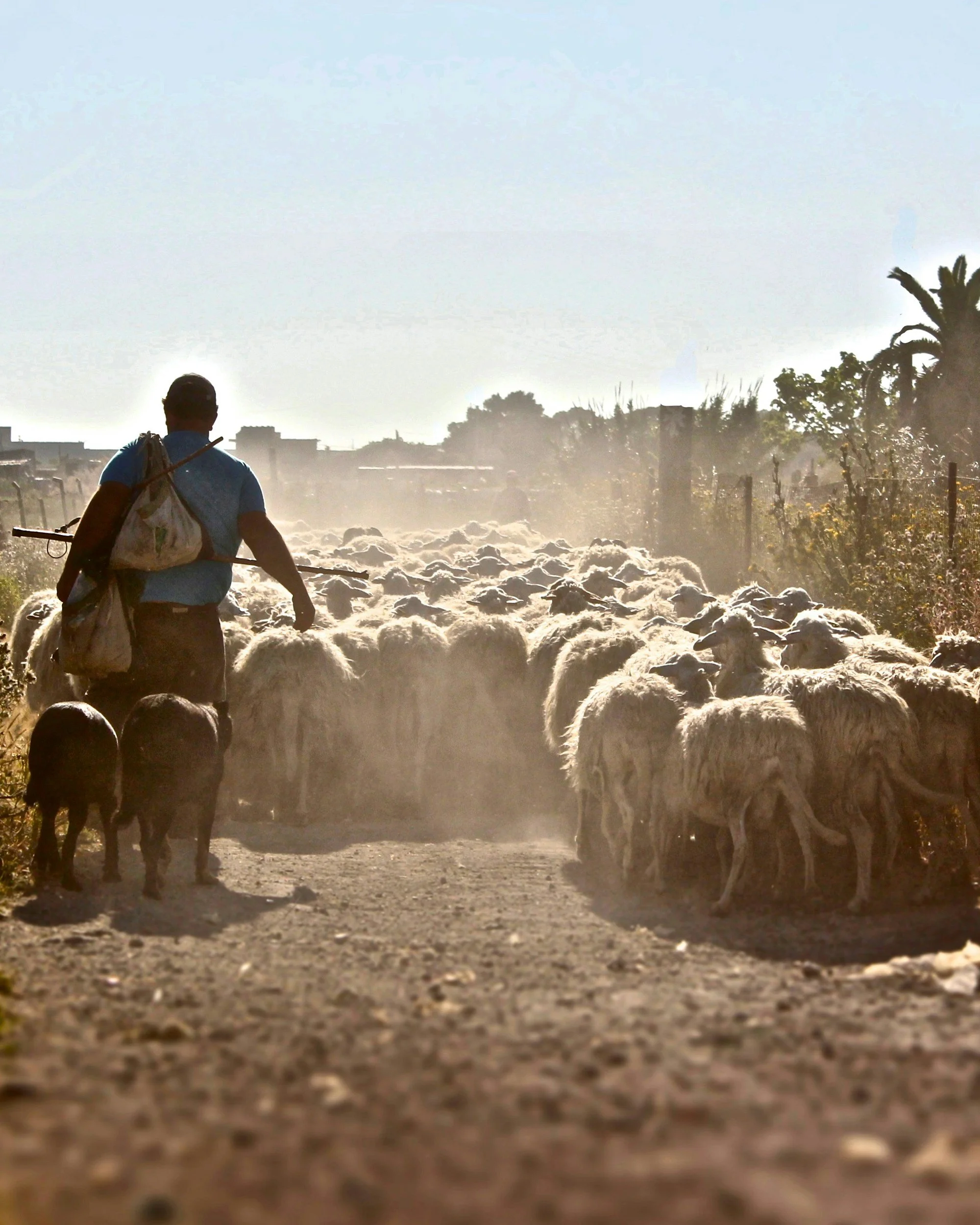
When Jesus calls himself the shepherd, his hearers would have understood at once. Shepherding was woven into daily life. They knew the risks and the cost.
That is where we need to do a bit of work.
For us—two thousand years later, after centuries of art and stained glass—the image can feel softened. We picture a serene figure in clean robes, gently holding a spotless lamb: peaceful, beautiful, almost effortless.
But that is not the image Jesus’ first hearers would have had.
It was not romantic. It was relentless.
And it is into that reality that Jesus says, “I am the good shepherd. The good shepherd lays down his life for the sheep.”
No one listening would have missed what he meant.
And that matters, because it tells us something profound about the risen Christ.
The one who stands alive among the disciples—who breaks bread and speaks peace—is not distant from the messiness of life.
He is not untouched by suffering or removed from danger. He is the shepherd who has known exhaustion and risk—and who chooses to stay.
Now listen again to Psalm 23.
“The Lord is my shepherd…
He makes me lie down in green pastures;
he leads me beside still waters;
he restores my soul.”
This is not the voice of someone who has never known hardship. It is the voice of someone who has walked through “the valley of the shadow of death.”
And notice this: the psalm does not say we avoid the valley.
It says, “Even though I walk through the valley… I will fear no evil.”
The shepherd’s presence does not erase the valley; it changes how we walk through it.
And that speaks directly to the world we find ourselves living in.
If we are honest, it can feel as though things are unraveling. Anxiety hangs in the air, and the ground beneath us feels less stable than we would like.
We carry personal worries—about health, relationships, and the future—and we see wider uncertainties in our communities and our world.
It does not take much for fear to begin shaping our hearts and minds. The valley has a way of holding our gaze and convincing us it is all there is.
But into that reality comes the voice of the risen Jesus.
“I am the gate.”
“I am the shepherd.”
Not: I was. Not: I will be someday. But: I am.
Present.
Active.
Near.
And what does that mean?
It means the deepest truth about reality is not chaos, but care. It means God’s defining posture toward us is not distance, but relationship. It means we are held by a love that knows us.
And that matters.
That is what shepherding is about. The shepherd knows the sheep—not as a statistic, but one by one: their habits, their frailties, their tendency to wander. And the sheep, in turn, learn the shepherd’s voice.
This is not abstract; it is personal.
To belong to God through Christ is to be known.
And here is where that uncomfortable part of the imagery becomes important again.
Because we do not always feel like the serene, spotless lambs in stained glass windows.
More often, we recognize ourselves in something far less tidy.
We know what it is to feel weighed down by mistakes, regrets, and habits we cannot seem to shake. We know what it is to wander—chasing what looks close enough—only to realize we have drifted from where we meant to be.
Like real sheep, we can end up stuck—unable to right ourselves without help.
And yet… the Gospel does not say the shepherd waits for us to clean ourselves up.
It says the shepherd comes—again and again—into the mess, into the danger, into the places where we are lost, where we are stuck, where we are afraid.
Again and again.

The good shepherd goes after the sheep, gathers them in his arms, and brings them home.
This is the power of the resurrection.
Not simply that Jesus is alive—though that is the beginning of everything—but that the one who is alive is this kind of shepherd.
A shepherd whose power is revealed not in domination, but in self-giving love. A shepherd who lays down his life in reality, not metaphor—who walks through death itself and comes out the other side to remain with the flock forever.
“I came that they may have life,” Jesus says, “and have it abundantly.”
That abundance is not the absence of difficulty.
It is fullness—belonging—life rooted in the unshakeable knowledge that we are known and held by God.
Even in the valley.
Especially in the valley.
So, the question for us this morning is not simply whether we believe these words.
It is whether we are willing to trust the voice of the shepherd over the noise of our fears.
Will we listen for that voice that calls us by name?
Will we allow ourselves to be led—even when the path is uncertain?
Will we trust that goodness and mercy are following us—even when we cannot see them?
Because the valley will still be there.
But it will not have the final word.
The final word belongs to the shepherd—the one who stands among us risen, present, alive: whose peace is stronger than our fear, whose love is deeper than our wandering, and whose care holds us when everything else feels like it is slipping away.
And so we return, once more, to that ancient confession:
“The Lord is my shepherd… I shall not want.”
Not because life is easy.
Not because the valley disappears.
But because the shepherd is with us.
And that—
that is enough.
Amen.